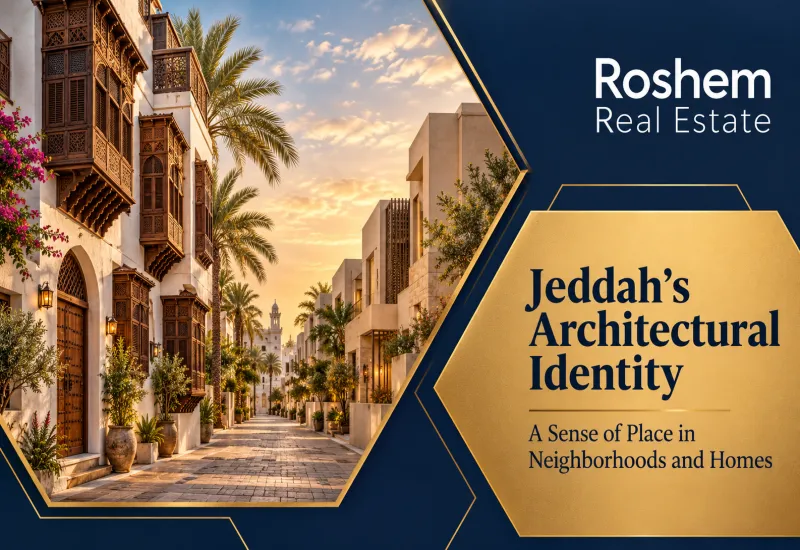
A city’s identity is shaped by more than its buildings. It emerges from the relationship between architecture, the surrounding environment, and the way people live. In Jeddah, this relationship is reflected in an architectural character influenced by the city’s coastal setting and its commercial and cultural history. Together, these influences give its homes and neighborhoods a distinctive sense of place.
As the city expands and housing needs evolve, preserving this character becomes increasingly important. The challenge is to balance local architectural identity with the demands of contemporary living.
How Does Jeddah’s Environment Influence Building Design?
The surrounding environment informs many architectural decisions, from the choice of building materials and the positioning of windows to façade treatments suited to the climate and location. In a coastal city such as Jeddah, natural ventilation, daylight, and shade are important considerations in residential design. Privacy also plays a significant role in the arrangement of interior spaces.
These considerations are closely connected to the architectural character that developed throughout the city’s history. Jeddah’s role as a trading center brought it into contact with diverse cultures, influencing its building details and construction practices. Hijazi architecture illustrates how buildings can respond to local conditions while combining practical functions with visual appeal.
Drawing on this identity therefore involves more than adding traditional features to a façade. It requires understanding why those features developed and how their underlying principles can inform buildings that meet residents’ needs today.
From Individual Façades to Neighborhood Character
Architectural identity extends beyond a single building to encompass the wider neighborhood and the relationship between its buildings, streets, and open spaces. Buildings may serve similar purposes yet connect with their surroundings in different ways through façade colors, materials, and design details.
Coordination between these elements can create a coherent urban setting without making every building identical or restricting design variety. Preserving local identity can leave room for architectural creativity, provided new designs remain sensitive to the character of their setting.
This approach is particularly relevant in new neighborhoods, where locally inspired features can be integrated with modern building requirements. It allows the city’s architectural identity to develop alongside its growth and changing housing needs.
How Does Neighborhood Design Affect Residents’ Quality of Life?
The quality of a residential environment depends on more than the size or interior layout of a home. Streets, walkways, public spaces, and nearby services also shape how residents experience their surroundings.
Ease of movement, access to everyday amenities, and comfortable places to walk and sit all influence how people use a neighborhood.
Public spaces provide opportunities for social interaction beyond the home, while pedestrian routes connect different parts of the neighborhood. Their success depends on how well they serve their users through accessibility, comfort, shade, and places to rest.
In Jeddah, the waterfront and open spaces have additional significance because of the city’s relationship with the sea. They form part of its coastal character and provide settings for everyday activities and recreation. This illustrates how geography can actively inform public-space planning rather than simply provide a backdrop.
How Can Jeddah Preserve Its Identity as It Expands?
Urban expansion creates opportunities to develop neighborhoods and homes that respond to changing needs. At the same time, it raises the challenge of preserving the architectural qualities that distinguish the city.
Addressing this requires treating local identity as part of the planning and design process, rather than confining it to historic buildings and heritage districts.
Design guidance informed by local characteristics can help identify features worth considering in new developments, including façade treatments, coordinated colors and materials, and architectural details. Such guidance can encourage visual harmony while allowing contemporary solutions suited to different uses and requirements.
Preserving architectural character does not require reproducing the past exactly. Instead, it involves drawing on its knowledge and design principles to create contemporary buildings. A modern building can express a sense of place through its response to climate, spatial organization, relationship with the street, and integration into the surrounding urban fabric.
Architecture as an Expression of Place
Jeddah’s architectural identity brings together its history, coastal environment, building characteristics, and neighborhood patterns. Its value becomes tangible when these qualities enrich everyday life, both within homes and across the streets and public spaces residents use.
As urban development continues, balancing local character with contemporary needs remains an important consideration in the design of new neighborhoods.
A place retains its identity through more than the appearance of its buildings. It also does so through its ability to accommodate daily life, respond to residents’ needs, and maintain the connection between architecture, history, and the local environment.